
“I’ve been feeling tired more easily lately.”
“My sleep doesn’t seem to be as deep as it used to be.”
“My neck and shoulders get stiff more easily.”
“My face seems to get puffy more often.”
“My skin just doesn’t seem to be the way it used to be.”
These are the small changes we notice in our bodies—changes that may not seem serious enough to warrant a visit to the doctor, but that we can nevertheless clearly feel.
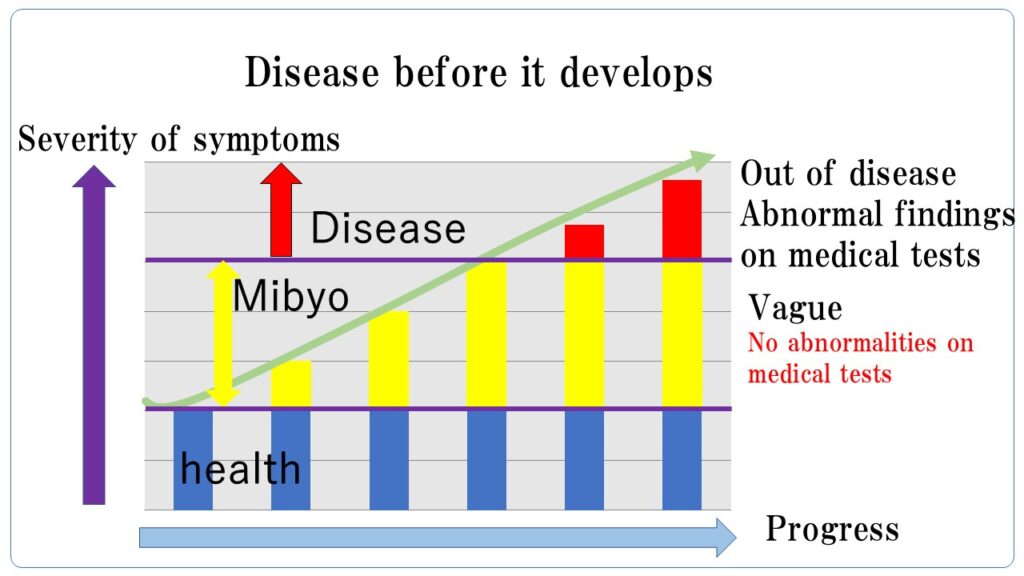
There are also times when medical tests show no significant abnormalities, yet we still feel that something about our health is not quite right.
We may dismiss these changes as simply “part of getting older” or tell ourselves that we are “just tired,” and leave them unaddressed.
However, the body does not suddenly change from one day to the next.
It gradually changes through our everyday lives, and the accumulation of these small changes can eventually manifest as more significant health problems.
The idea of paying attention to these subtle changes in the body before they develop into a clearly identifiable illness is closely connected to the traditional Eastern medical concept of Mibyo
What Is “Mibyo”in Traditional Eastern Medicine?
The term “Mibyo” is a concept that has been used in traditional Eastern medicine for centuries.
Literally, it means “not yet ill” or “illness that has not yet manifested.”
However, simply thinking of Mibyo as “the stage just before becoming sick” does not fully capture the meaning of the concept.
In traditional Eastern medicine, Mibyo can be understood as an important way of thinking about health that encourages us to notice small changes occurring in the body before they develop into a clearly recognizable illness, and to use those changes as an opportunity to think about our future health.
For example, you may notice that:
- You get tired more easily than you used to.
- Your sleep has become lighter.
- Your digestive system feels less consistent than before.
- You have started to feel more sensitive to the cold.
- Your neck and shoulders become stiff more easily.
- Your head feels heavy more often.
- You tend to experience swelling or puffiness more easily.
- You have been feeling more stressed lately.
These are all examples of subtle changes that may make us feel that something is slightly different from the way we used to feel.
Of course, experiencing any of these symptoms does not necessarily mean that an illness is developing.
At the same time, there is value in not simply dismissing small changes in the body as “just the way things are,” but instead recognizing them as signals from our bodies that deserve our attention.
In traditional Eastern medicine, these kinds of changes are taken into consideration while looking not only at the area where a symptom appears, but also at the overall condition of the individual.
Based on the condition of the body, this may involve reviewing daily habits, getting adequate rest, keeping the body warm, incorporating appropriate exercise, or making use of acupuncture and other forms of care as part of an ongoing approach to health.
This is the way traditional Eastern medicine approaches the concepts of Mibyo and Yojo, or cultivating and maintaining one’s health through everyday care.
It Is Precisely When You Think “I’m Still Fine” That It Is Worth Paying Attention to Your Body
We often do not think seriously about taking care of our bodies until we experience significant pain or our health deteriorates noticeably.
But in reality, the body has often been sending us various signals long before that point.
For example, suppose you notice that “I don’t seem to recover from fatigue as easily as I used to.”
Rather than simply attributing it to age, it can be helpful to ask yourself:
Am I getting enough sleep?
Have I been under continuous stress at work or at home?
Have I become less physically active?
Have my mealtimes or eating habits become irregular?
Simply taking a moment to reflect on these questions can provide an opportunity to reconsider the way you live your daily life.
The same applies to stiff shoulders. The cause does not necessarily lie in the shoulders themselves.
Long hours of desk work, smartphone use, poor posture, lack of exercise, insufficient sleep, and psychological tension can all play a role.
That is why it is important not only to look at one particular part of the body, but also to consider why the body has come to be in its current state.
Traditional Eastern Medicine and the Approach of Acupuncture
When people hear the word “acupuncture,” many may imagine something like “acupuncture for shoulder stiffness means placing needles in the shoulders” or “acupuncture for lower back pain means placing needles in the lower back.”
Of course, assessing the area where pain or muscular tension is occurring and treating that area appropriately is important.
At the same time, traditional Eastern medicine also looks beyond the location of a symptom and considers the overall condition of the body that may lie behind it.
For example, if someone says, “My shoulders have been getting stiff lately,” we may consider questions such as:
Are you getting enough sleep?
Has fatigue been building up?
Have you been experiencing increased levels of stress?
Have you had less time to move your body?
Has your daily routine become irregular?
Taking these factors into consideration allows treatment to be tailored to the individual and their particular condition.
This approach is also connected to the way traditional Eastern medicine has historically viewed the body—not as a collection of separate parts, but as an interconnected whole.
Of course, acupuncture cannot address every illness or symptom.
If severe pain persists, if you experience a sudden change in your physical condition, or if you have symptoms that may require medical testing, it is important to seek an appropriate evaluation from a medical professional.
With that in mind, acupuncture can also be used as one way to support daily physical well-being, health maintenance, and overall conditioning.
Cosmetic Acupuncture and Mibyo Are Actually Closely Connected
Now, let us take a closer look at cosmetic acupuncture.
When people think of cosmetic acupuncture, they may imagine approaches aimed at visible changes in the face, such as:
“Facial sagging”
“Nasolabial folds”
“Puffiness”
“Skin firmness”
“Facial contours”
“The appearance of the eyes”
Of course, cosmetic acupuncture may involve placing acupuncture needles in areas such as the face and scalp.
However, from the perspective of traditional Eastern medicine, it is important not to look only at the face, but also at the body as a whole.
For example, suppose you notice that “my face has been getting puffy more easily lately.”
Rather than viewing this simply as an issue with the face, we also consider the condition of the body as a whole:
Are you getting enough sleep?
Has fatigue been building up?
Have you been staying in the same position for long periods of time?
Has your daily routine become irregular?
Have you been under continuous stress?
The face is one of the areas where changes related to our everyday lifestyle and physical condition can be particularly easy to notice.
That is why there can be great value in using cosmetic acupuncture as an opportunity to take a broader look at your overall health and daily habits.
Cosmetic Acupuncture Is Not Simply About “Looking Younger”
When it comes to cosmetic acupuncture, we sometimes come across terms such as “anti-aging” and “rejuvenation.”
However, we do not believe that beauty should simply be about “returning to the way you looked when you were younger.”
Growing older is a natural part of life for everyone.
What matters is not fighting the aging process, but appreciating the beauty and sense of well-being that belong to you at each stage of your life.
To do that, it is important to look beyond the skin itself and pay attention to the many aspects of daily life that influence how we feel and look—including sleep, diet, exercise, stress, posture, and physical fatigue.
Cosmetic acupuncture can serve as one opportunity to begin doing just that.
You may initially seek treatment because you simply “want to look better,” but during the process, you may begin to notice things such as:
“I haven’t been getting enough sleep lately.”
“My neck and shoulders have been tense this whole time.”
“I haven’t really been taking care of my body.”
That realization can become an opportunity to reconsider your lifestyle and daily habits.
This is where cosmetic acupuncture and the concept of Mibyo intersect.
How Grand Treatment Clinic Views Beauty and Health
Omotesando is home to a wide variety of services related to beauty and wellness.
Among them, what we value at Grand Treatment Clinic is not viewing “beauty” and “health” as two separate things.
Taking care of your body can support your beauty. And taking an interest in your own beauty can, in turn, encourage you to take better care of your body.
We also believe in looking beyond your current condition and considering your body and well-being in the context of the life you want to live in the years ahead.
If receiving cosmetic acupuncture becomes more than simply “time spent improving the way your face looks today,” and instead becomes a moment to pause and ask yourself, “How is my body doing right now?”, then we believe that experience can have much deeper meaning.
Mibyo Care Is an Investment in Your Future Self
Our bodies are not created in a single day.
The sleep you get today.
The food you eat today.
The exercise you get today.
The way you deal with stress today.
And whether or not you choose to take care of your body today.
All of these things accumulate over time and contribute to the person you will be several years from now, and even ten years from now.
That is why the concept of Mibyo cannot be fully expressed simply as “disease prevention.”
It can also be understood as the idea that by taking care of who you are today, you are nurturing the person you will become in the future.
Traditional Eastern medicine has a concept known as “yojo,” which emphasizes cultivating and maintaining health through everyday life. In the same way, health is not something that can be achieved through a single effort. It is something we gradually nurture through our daily habits and choices.
Acupuncture is one of the many ways we can support that process.
What Can You Do for the Person You Will Be at 80?
When I imagine myself at 80, I would rather look back and think, “I’m glad I took good care of my body,” than “I wish I had taken better care of myself.”
To create that kind of life, perhaps we do not need to make dramatic changes or start doing anything extraordinary.
We can simply place a little more importance on sleep.
Review our diet.
Move our bodies.
Avoid allowing stress to build up too much.
Check in with our physical condition regularly.
And, most importantly, pay attention to the small signals our bodies are sending us instead of ignoring them.
These small, everyday choices are what lead us toward Yojo—cultivating and maintaining our health.
Understanding Mibyo Means Thinking About Your Future
We can wait until we become sick before seeking treatment.
We can wait until pain appears before taking care of our bodies.
We can wait until changes in our skin become more noticeable before beginning a beauty routine.
But there is another way.
We can also choose to pay attention to the small changes that make us think, “I don’t feel quite like myself lately.”
This is the essence of the concept of Mibyo.
The concept of Mibyo has long been valued in traditional Eastern medicine.
Modern medicine emphasizes prevention, early detection, and improvements in lifestyle habits.
Acupuncture and cosmetic acupuncture offer their own approaches to supporting the body.
By making use of the strengths of each, we can find a way of caring for our health that works for us and helps us stay connected to our own bodies.
At Grand Treatment Clinic, this is the kind of relationship with health that we value.
To live beautifully and in good health.
This does not mean returning to the person you were when you were younger.
It means understanding who you are today, taking care of yourself today, and nurturing the person you will become in the future.
We hope that the care you give your body today can become a gift to your future self.
Grand Treatment Clinic, an acupuncture clinic in Omotesando, is committed to supporting each individual in their journey toward “living beautifully and in good health” through acupuncture and cosmetic acupuncture.
Understanding Mibyo.
Noticing the changes in your body.
And beginning today to take care of your body for the sake of your future self.
These may be among the most important messages that traditional Eastern medicine has to offer those of us living in the modern world.